
Information influencing
Updated December 2025
- Information influencing (Foreign Information Manipulation and Interference, FIMI) covers several forms of hybrid influencing, such as propaganda, traditional and social media manipulation, fake news, information leaks, human agents and cyber activities.
- A report by the European External Action Service presents the trends in information influencing in 2024.
- The network infrastructure used by Russia and China for information influencing covers several platforms and geographical areas.
- Interaction with a wide network of channels connected to state actors
- Ukraine remains a continuous victim of attacks.
- France, Germany, Moldova and sub-Saharan Africa, especially the Sahel, are also heavily targeted.
- Elections are key targets of attacks.
- Information attacks also on organizations and individuals.
- The EU, NATO and independent media are the most frequently targeted.
- Social media platforms are one of the most important channels for influencing information.
- 88 % of the observed activity in X (formerly Twitter)
- Coordinated inauthentic behaviour and the creation of inauthentic news sites
- Using AI as an inexpensive method to create inauthentic content
- Information influencing networks tailor their operations to geopolitical changes and local conditions.
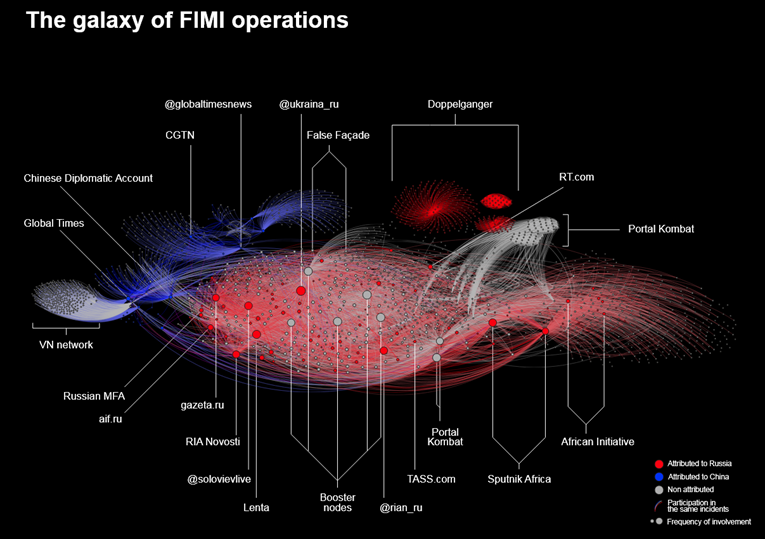
The Galaxy of FIMI operations. Image source: 3rd EEAS Report on Foreign Information Manipulation and Interference Threats.
Read more
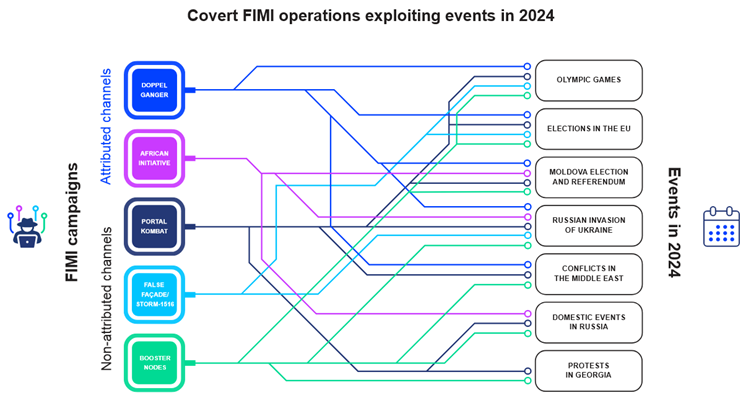
Covert information influence operations targeting various events in 2024. Image Source: 3rd EEAS Report on Foreign Information Manipulation and Interference Threats.
The network infrastructure of Russia and China in information influencing spans several platforms and geographical areas, which highlights the scale and complexity of the threat to democracies. Official and named channels are just the tip of the iceberg in information influencing. These interact with a vast network of channels connected to states that are hidden from the public.
The report of the European External Action Service provides an overview of the key trends in information influencing in 2024. As many as 90 countries have been targeted, highlighting the global nature of the threat. Ukraine remains a continuous victim of the attacks, with almost half of the recorded incidents. France, Germany, Moldova, and sub-Saharan Africa were also heavily targeted. Elections were the main target of attacks in 2024, when more than half of the world’s eligible voters went to the polls. Information attacks were also targeted at organizations and individuals. The EU, NATO, and the independent media were the targets of many at-tacks.
Social media platforms remained the most important channels for influencing information. 88 % of the detected activity occurred on X (formerly Twitter). Key tactics, techniques, and procedures included botnets and coordinated inauthentic behaviour, as well as the creation of inauthentic news sites. The use of generative AI provided a low-cost option for threat actors to produce inauthentic content and expand the scope of their activity. The EU report presents case studies of Russian campaigns in Moldova and Africa, as well as one operation originating in China, illustrating how information influence networks adapt their strategies to geopolitical changes and local conditions.
Sources and links
Government’s Defence Report (2021):
http://urn.fi/URN:ISBN:978-952-383-852-9
Government report on changes in the security environment (2022):
http://urn.fi/URN:ISBN:978-952-383-811-6