
Finland as part of NATO’s common deterrence and defence
Updated June 2026
- Rights and obligations under Article 5 of the NATO Treaty:
- security guarantees that raise the threshold for attacking Finland,
- defending NATO allies.
- Finland is primarily responsible for defending its own territory, with the help of other NATO countries.
- General conscription and the comprehensive security model
- Participation in the planning and implementation of NATO’s collective defence
- NATO’s Defence Planning Process
- Finland’s NATO membership does not affect the status of the Åland Islands as established by international agreements. The defence of the Åland Islands remains Finland’s responsibility.
- Part of NATO’s joint air and missile defence system
- Participation in NATO exercises in Finland and other NATO countries
- Participation in NATO operations is based on Finland’s sovereign national decision-making
- Finland participates in NATO’s Allied Reaction Force activities by contributing troops that are trained and equipped for crisis management missions to the force pool
- Exchange of intelligence and situational awareness
- The deployment of military personnel within NATO’s command structure
- NATO’s presence in Finland: Army Command and the command-and-control elements of the FLF Rapid Response Force
- Finland as a part of NATO’s command structure and command system
- Participation of the Defence Forces in NATO’s peacetime military activities
- Costs associated with NATO membership

Finnish coastal jaegers from the Uusimaa Brigade disembark the Swedish Navy’s CB-90 assault craft near Tovik in Norway before the Nordic Response 24 exercise. Image source: NATO image bank.
Read more
According to Article 3 of the NATO Treaty (North Atlantic Treaty 1949), the member states must maintain both their own and their collective ability to defend themselves against armed attacks. However, Finland decides on the implementation principles of its own defence and is primarily responsible for defending its own territory, but it will receive help from other NATO countries if necessary.
NATO’s deterrence and defence are of fundamental importance to Finland’s security. The significance of NATO membership and the security guarantee this membership brings raises the threshold of attacking Finland. On the other hand, Finland’s strong defence capability and crisis resilience also strengthen the alliance. According to the Government’s Defence Report, Finland will maintain and develop a strong national defence capability based on general conscription and comprehensive national defence in all circumstances. Finland’s military defence is coordinated with and complements NATO’s deterrence and defence.
According to the Government’s Report on Foreign and Security Policy, Finland is committed to NATO’s deterrence and common defence across the entire alliance and with all threat scenarios in mind. As a member of NATO, Finland is prepared to support other NATO countries and to receive troops from other members to strengthen its own national defence. Finland also actively participates in the development of NATO’s nuclear weapons policy. When applying for NATO membership, Finland did not set any restrictions on participation in the alliance’s activities. NATO has announced that it will be a nuclear alliance as long as nuclear weapons are in use elsewhere.
As a member of NATO, Finland examines nuclear weapons issues not only from the perspective of arms control and disarmament, but also from the perspective of deterrence and defence. The North Atlantic Treaty does not contain provisions on nuclear weapons. The implementation of nuclear weapons policy is steered by the Nuclear Planning Group (NPG), in which member states are represented by their defence ministers.
Finland will continue its active and constructive arms control and disarmament policy to strengthen both national and international security. Finland emphasizes full compliance with arms control agreements and the implementation of confidence-building measures. Finland is working to prevent the proliferation of weapons of mass destruction and to combat the threats they pose. The Treaty on the Non-Proliferation of Nuclear Weapons (NPT) is the primary treaty for promoting nuclear disarmament and non-proliferation.
The Defence Forces will participate in NATO’s defence planning and operational planning processes, as well as in the command-and-control arrangements, exercises and operational activities required by it.
The NATO Defence Planning Process (NDPP) operates on the basis of a four-year cycle, and its purpose is to develop the joint capabilities of the member states and NATO as a whole. In 2025, new capability targets for defence planning were established for all member states. They will be included in the Finnish Defence Forces’ development programme. Finland participates in NATO’s peacetime collective defence tasks, other NATO military activities, and sends personnel to serve in NATO structures and headquarters. The number of personnel needed for this is estimated to be around 100–200.
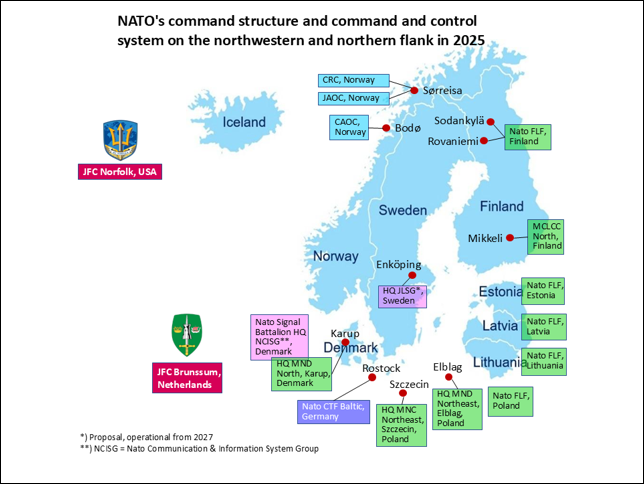
Finland is part of NATO’s command-and-control structure, and Finnish territory falls within the area of responsibility of NATO’s Supreme Allied Commander Europe (SACEUR). Finland maintains national operational plans for the defence of its own territory, and these plans serve as the foundation for NATO’s regional planning and operations. Finland is also integrated into NATO’s joint air and missile defence system.
In February 2026, SACEUR decided to launch Operation Arctic Sentry, which will help NATO strengthen deterrence and defence in the Arctic region, a strategically important area to the Alliance. It is important for Finland that NATO addresses the threat posed by Russia and China’s growing role in the Arctic region as well.
Arctic Sentry provides the framework for NATO’s Arctic operational activities, including maritime and air surveillance and reconnaissance missions. It also encompasses exercises such as Cold Response exercises, in which Finland participates. The newly established NATO Multi-Corps Land Component Command (MCLCC) in Mikkeli and the advanced army force Forward Land Forces (FLF) Finland in Rovaniemi and Sodankylä, are also part of the Arctic Sentry framework.
In March 2026, Riihimäki was chosen as the location of the NATO Command and Control Unit, and it is scheduled to start operating at the beginning of 2027. The command-and-control systems units are led by NATO’s Communications and Information Systems Group (NCISG). The task is to provide telecommunications and information system services. The unit employs only Finns, a total of about 60 people.
The exchange of intelligence with other NATO countries is increasing. Finland participates in maintaining NATO’s common situational awareness and intelligence gathering and receives information on the military operating environment through NATO. One example of operational-level intelligence cooperation is the conduct of surveillance and reconnaissance flight operations in Finnish airspace together with key allies.
NATO’s peacetime missions are carried out with the Forward Land Forces (FLF) on the eastern flank of the alliance, the Standing Naval Forces (SNF), and the Air Policing and Air Shielding missions of air defence.
All Nordic countries fall under the responsibility of Joint Force Command Norfolk (JFC Norfolk) in the United States.
The Multi-Corps Land Component Command (MCLCC) in Mikkeli, Finland, operates under JFC Norfolk and is responsible for NATO’s ground operations in Northern Europe. The MCLCC is an army-level command that can lead operations involving several army corps. It is located within the Finnish Army Command in Mikkeli and is commanded by the Commander of the Finnish Army, who performs the role in addition to his primary duties. The MCLCC is responsible for NATO’s exercises and other peacetime activities in its area, and in a crisis, it leads NATO’s ground operations in the region. The personnel will consist of both NATO allies and members of the Finnish Defence Forces.
The FLF troops in Finland will be led by Sweden. The core of FLF Finland will be a Swedish battalion-size battlegroup of around 600 highly-trained soldiers with an ability for rapid transfer from their base in Boden to Finland. The battle group will be set up by the Norrbotten Regiment (I 19) based in Boden. The regiment serves as the centre of subarctic warfare for the Swedish Armed Forces. The other participating countries will be NATO countries that have capabilities suitable for Finland’s conditions and military and political grounds for a long-term commitment to Finland. In addition to Sweden, at least the United Kingdom, France, Norway, Denmark, Iceland, and Italy have announced their participation in this FLF group. Its command structure will be permanently stationed in Finland, but the actual troops will only regularly visit Finland for exercises with Finnish troops. FLF Finland’s combat troops will primarily focus on operations in Northern Finland and will mainly be based in Rovaniemi and Sodankylä. In peacetime, NATO’s ability to rapidly reinforce Finland’s FLF force will also be practiced. The operations of the FLF force are based on NATO’s operational planning, and when readiness is increased, the unit can be strengthened into a brigade.
Rovaniemi has been confirmed as the location of the Multinational Staff Element (MNSE) supporting the FLF Army Forces. The MNSE will constitute FLF Finland’s permanent presence in Northern Finland. Half of the positions in the MNSE are expected to be filled by Finnish and Swedish personnel, while the remainder will be staffed by personnel from the United Kingdom, Italy, France, Denmark, Norway, and Iceland. The peacetime strength of the MNSE is on a par with that of the MCLCC Headquarters in Mikkeli. Both headquarters are expected to employ a few dozen people.
NATO’s naval component in the Baltic Sea is led by the HQ Commander Task Force Baltic (CTF Baltic), established in 2024, which currently operates in conjunction with the German Naval Command in Rostock. In addition to soldiers from Germany, the staff of the Headquarters includes soldiers from Italy, France, the United Kingdom, the Netherlands, Denmark, Sweden, Poland, Lithuania, Latvia, Estonia, and Finland.
In 2027, Finland will contribute to NATO’s peacetime maritime activities by deploying one Katanpää-class vessel to the Standing NATO Mine Countermeasures Group One (SNMCMG1) and, if required, one Hamina-class vessel to the Standing NATO Maritime Group One (SNMG1).
Finland has decided to participate in NATO’s multinational MRTT (Multi Role Tanker Transport) programme, which was established by several NATO countries to maintain a multinational air-to-air refuelling and transport aircraft squadron.
In January 2026, a Defence Innovation Accelerator was established in Finland as part of NATO’s Defence Innovation Accelerator for the North Atlantic (DIANA). Its activities will focus on next-generation communication technologies and support start-ups and SMEs in developing dual-use innovations for both defence and civilian applications.
NATO has a new rapid reaction force, the Allied Reaction Force (ARF), which is intended to be used for all tasks of the alliance in accordance with the decisions of the NATO Council. Finland is preparing to participate in the activities of the ARF force in the future.
The direct costs of Finnish NATO membership consist of contributions to NATO’s common budgets and participation in NATO activities. The contributions are based on the size of the member states’ economies. Finland’s share of NATO’s budget expenditure is about 0.9 %, which means EUR 70–100 million per year. Joining NATO’s defence planning process and the implementation of the capability goals targeted at Finland, as well as participating in NATO’s operational planning and operations, will bring significant additional costs.
At the NATO summit in 2025, it was decided that the defence spending of the member states should be at least 5 % of each country’s gross domestic product (GDP) by 2035. Finland supported this and will try to act accordingly. NATO has also previously agreed that at least 20 % of defence spending must be used for the procurement of defence materiel.
Finland’s integration into NATO’s common defence systems will be a long process. As a result of the additional tasks caused by NATO membership, the Defence Forces will need additional personnel.
The Government’s current affairs report, published in April 2026, highlighted the need to develop a more “European” NATO. In addition, Finland’s full commitment to NATO’s common deterrence and defence was reaffirmed and emphasised.
Sources and links
Government’s Defence Report (2024):
http://urn.fi/URN:ISBN:978-952-383-852-9
Government Report on Finnish Foreign and Security Policy (2024):
http://urn.fi/URN:ISBN:978-952-383-929-8
The North Atlantic Treaty (1949):
https://www.nato.int/cps/en/natohq/official_texts_17120.htm
https://www.defmin.fi/en/areas_of_expertise/finland_s_membership_in_nato#824ca4b4
https://puolustusvoimat.fi/en/natoen
https://um.fi/north-atlantic-treaty-organisation
OSW: NATO’s northern flank: allied forces and structures in the Nordic countries. 7 October 2025.
Government report on changes in the foreign and security policy environment, 16 April 2026:
https://urn.fi/URN:ISBN:978-952-383-359-3