
Hybrid influencing in Europe and especially in the Baltic Sea region
Updated December 2025
The effects of the war in Ukraine have also appeared as hybrid influence activities in the Baltic Sea region. Digital as well as physical means of influence have been targeted at the infrastructure of Western countries supporting Ukraine. In most cases, it has been either very difficult or impossible to identify the actors responsible for those operations.
Russia is waging an increasingly aggressive campaign of sabotage and subversion against European and American targets across Europe. According to CSIS reporting, the campaign is led by Russian military intelligence (GRU). The number of Russian attacks nearly tripled in 2023 and 2024. Russia’s primary targets have included transport, public administration, critical infrastructure, and industry, with tactics ranging from the use of explosives and blunt or sharp objects (such as anchors) to electronic attacks.
Read more

Examples of GPS jamming in the Baltic Sea Region in April 2024. Image source: Daily maps of GPS interference, gpsjam.org.
Russia’s actions against Europe’s critical infrastructure since 2022
In Finland, the Finnish Security Intelligence Service (Supo) has assessed recent suspected sabotage activities in Europe and concluded that Russia uses intermediaries to spread fear and burden authorities with sabotage measures. According to the Swedish Security Police, Russia also conducts extensive and varied sabotage operations across Europe. Russia pays intermediaries, such as criminals, to carry out these sabotage operations. Lithuanian authorities have stated that they suspect that Russian military intelligence services were involved in the arson attack of an Ikea store in 2024. The same actors are also suspected of causing a fire in Poland’s largest shopping centre. Moreover, a major oil spill in Norway is suspected to be the result of sabotage. Similar sabotage activities associated with Russia elsewhere in Europe have aimed to both intimidate and undermine support for Ukraine. In this way, Russia seeks to influence European public opinion and citizens’ sense of security, as well as to place an additional burden on the authorities.
According to the Finnish Security Intelligence Service, state-led intelligence gathering and broader influence efforts have relied on the use of proxy actors. An example of the use of proxy actors is sabotage activities in Europe linked to the Russian military intelligence service (GRU). Russia wants to cover its tracks by using intermediaries while seeking to influence public opinion, citizens’ sense of security, and burden the authorities. Their current overarching goal now is to weaken Western support for Ukraine.
In May 2024, the Russian Ministry of Defence announced that the Russian government was reassessing Russia’s maritime borders in the Baltic Sea to “correspond to the modern geographical situation.” Finland was not informed about these intentions in advance. The normal practice would have been to notify other states through official channels. It has been assumed that this may have been a hybrid operation intended to test how Finland acts and how NATO reacts.
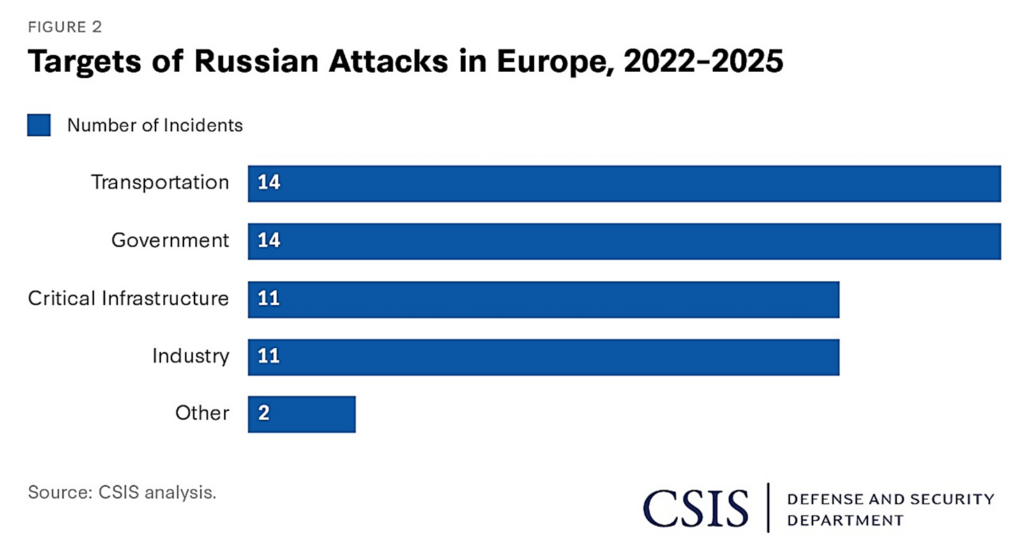
Image source: Center for Strategic & International Studies, Russia´s Shadow War Against the West.
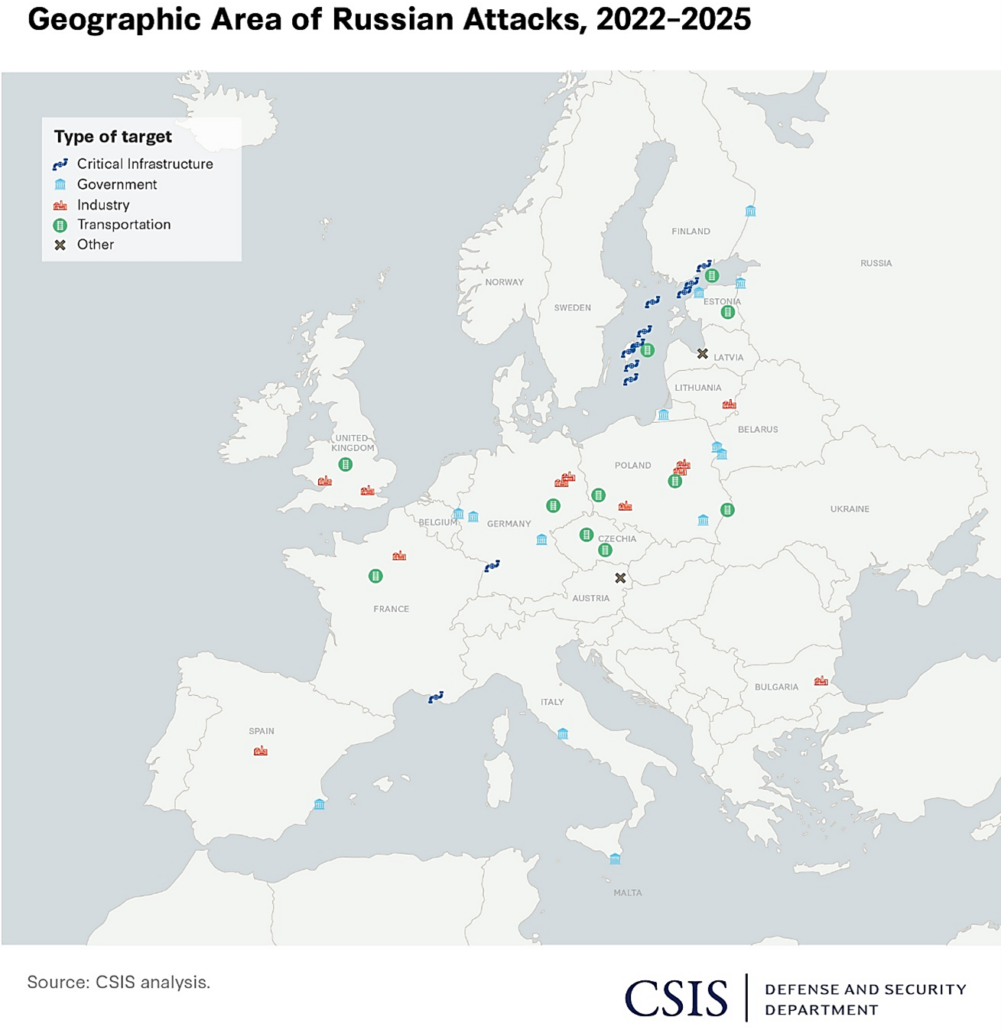
Image source: Center for Strategic & International Studies, Russia´s Shadow War Against the West.

Targets and means of Russia’s hybrid warfare in Europe 2018–2025. Image source: The International Institute for Strategic Studies, Research paper: The Scale of Russian Sabotage Operations against Europe´s Critical Infrastructure.
Since Russia invaded Ukraine in 2022, it has also intensified its unconventional war against Europe. The goals of Russia’s campaign of sabotage, vandalism, espionage, and covert operations are to destabilise European governments, weaken support for Ukraine by inflicting social and economic costs on Europe, and weaken the joint capabilities of NATO and the EU in responding to Russian aggression.
So far, Russia has not achieved its goal, and European countries have responded to the operations. However, European countries have found it challenging to agree on coherent countermeasures, coordinating actions, developing effective deterrence measures, and on how to incur sufficient costs for Russia.
Information on suspected and confirmed Russian sabotage operations reveals that Russia’s decentralised sabotage activities have primarily targeted critical infrastructure in Europe. The countermeasures taken by NATO, the EU and the member states have not affected the operations. Russia has taken advantage of gaps in the legal system and has been able to avoid blame and responsibility.
Since 2022, hundreds of Russian intelligence officers have been expelled from European countries, but Russia has been effective in recruiting third-country nationals online to circumvent European counter-espionage activities. The tactic has proven successful in terms of scale and reach, enabling large-scale operations. A key challenge for Russian intelligence services has been the capabilities of these intermediaries, as they are often poorly trained or equipped, making their activities more susceptible to detection or failure.
Russia’s military doctrine integrates sabotage of critical infrastructure into hybrid warfare. European critical infrastructure is particularly vulnerable to sabotage, as much of it has been in poor condition for decades due to insufficient maintenance and limited investment. Russia has targeted this infrastructure to gain direct strategic advantages in its war in Ukraine and as part of its broader confrontation with the West.
Some initiatives, such as NATO’s Baltic Sentry naval operation in the Baltic Sea, have been particularly effective, but a lack of resources has limited long-term, sustainable action
Sources and links
Examples of GPS jamming in the Baltic Sea Region in April 2024. Image source: Daily maps of GPS interference, gpsjam.org.
Russia’s actions against Europe’s critical infrastructure since 2022
In Finland, the Finnish Security Intelligence Service (Supo) has assessed recent suspected sabotage activities in Europe and concluded that Russia uses intermediaries to spread fear and burden authorities with sabotage measures. According to the Swedish Security Police, Russia also conducts extensive and varied sabotage operations across Europe. Russia pays intermediaries, such as criminals, to carry out these sabotage operations. Lithuanian authorities have stated that they suspect that Russian military intelligence services were involved in the arson attack of an Ikea store in 2024. The same actors are also suspected of causing a fire in Poland’s largest shopping centre. Moreover, a major oil spill in Norway is suspected to be the result of sabotage. Similar sabotage activities associated with Russia elsewhere in Europe have aimed to both intimidate and undermine support for Ukraine. In this way, Russia seeks to influence European public opinion and citizens’ sense of security, as well as to place an additional burden on the authorities.
According to the Finnish Security Intelligence Service, state-led intelligence gathering and broader influence efforts have relied on the use of proxy actors. An example of the use of proxy actors is sabotage activities in Europe linked to the Russian military intelligence service (GRU). Russia wants to cover its tracks by using intermediaries while seeking to influence public opinion, citizens’ sense of security, and burden the authorities. Their current overarching goal now is to weaken Western support for Ukraine.
In May 2024, the Russian Ministry of Defence announced that the Russian government was reassessing Russia’s maritime borders in the Baltic Sea to “correspond to the modern geographical situation.” Finland was not informed about these intentions in advance. The normal practice would have been to notify other states through official channels. It has been assumed that this may have been a hybrid operation intended to test how Finland acts and how NATO reacts.
Kuvalähde: Center for Strategic & Image source: Center for Strategic & International Studies, Russia´s Shadow War Against the West.
Image source: Center for Strategic & International Studies, Russia´s Shadow War Against the West.