
Finland as space actor
Updated December 2025
- ESA’s programmes as the backbone of Finnish space activities
- Space Strategy 2030
- New opportunities for Finland
- Space as part of the Defence Forces’ operating environment
- Growing capabilities through collaboration

Illustrative image of Iceye’s satellite above Scandinavia. Image source: Iceye.
Read more
The space industry and its geopolitical operating environment have changed significantly in recent years. Between 2018 and 2022, the industry has grown globally by 30%. In Finland, there are about 200 companies active in the field, and their turnover from space activities has roughly tripled during this same period. Finland’s capability for space activities is largely based on European cooperation. In addition, Finland has bilateral partnerships and various letters of intent.
ESA’s programmes form the backbone of Finnish space activities. Finland has been a full member of ESA since 1995. Finland’s space activities are affected by its membership in the European Organisation for the Exploitation of Meteorological Satellites (EUMETSAT) and, since the beginning of the 2000s, also by EU space activities.
The vision of the Space Strategy 2030, published in 2025, is pursued through four goals:
- Utilisation: In Finland, space services streamline and enhance the security of operations throughout society.
- Operating environment: Finland is an inspiring, safe and predictable environment for space operators.
- Operational capability: Finland has the capabilities to develop, produce and utilise space services.
- International cooperation: Finland is a reliable and sought-after partner that actively contributes to the space sector.
The Ministry of Economic Affairs and Employment acts as Finland’s primary authority for space affairs and is responsible for the coordination, legislation, and international representation of the country’s space administration. The Finnish Space Advisory Board operates under the Ministry of Economic Affairs and Employment, bringing together the perspectives of different administrative branches. The advisory board is responsible for the implementation of Finland’s space strategy.
In 2024, the Government decided to establish a Space Situational Awareness (SSA) centre in Finland. Its operational functions will be built within existing organisations. The Space Situation Centre’s Civilian Command Centre, AVATIKE (C-FSSAC), will be established within the Finnish Meteorological Institute to provide services for civil society, with the National Land Survey of Finland as a key partner. The Finnish Defence Forces will establish a separate military centre (M-FSSAC).
Finnish space expertise is known for its high-quality space and atmospheric research as well as its competence in the electronics and software of space components. Finnish companies and research organisations have participated in the design and preparation of dozens of satellites, both in ESA’s projects and with international partners.
The EU’s space programme provides member states with services in satellite navigation, remote sensing, satellite telecommunications, and space object monitoring, and is Finland’s key partner in operational activities. The EU’s Space Strategy for Security and Defence and Finland’s NATO membership are central international frameworks for actors involved in comprehensive security.
The transformation of the space industry, the so-called “New Space”, refers to space activities carried out by new and often commercially driven actors in the field, operating independently of typical state-led programmes. Small satellites and private launch services enable faster, easier, and more cost-effective access to space.
The Finnish company ICEYE, which began as a startup, has launched 48 satellites into space and plans to send 50 more. It has the most radar satellites in orbit of any private company in the world. The ICEYE satellite constellation consists of small synthetic aperture radar (SAR) satellites that provide high-resolution images of the Earth’s surface, regardless of the weather conditions or time of day.
The 2024 Defence Report highlighted space as an important part of the military operating environment. The military use of space is divided into satellite services, space operations and environment monitoring, space situational awareness, intelligence and surveillance, counter-space operations, time and spatial data, and satellite communications. From the perspective of Finland’s defence, the focus is on satellite intelligence, satellite communications and time and location data (PNT services). The support provided by space for military operations is an important part of modern warfare.
The Commander of the Air Force also serves as the Space Commander of the Finnish Defence Forces. The Space Commander’s task is to create the necessary structures for operations and to integrate the different operational areas under unified management and a single strategic framework. Preparations are underway to start the operations of the Finnish Defence Forces’ Space Operations Centre. Its tasks will include the formation of a comprehensive space situational picture and distributing it to the Defence Forces units.
In June 2025, the Ministry of Defence signed a letter of intent with ICEYE to procure SAR satellites. The acquisition complements the Finnish Defence Forces’ ISR (Intelligence, Surveillance, Reconnaissance) capabilities by providing its own satellite system. In cooperation with ICEYE, the Finnish Defence Forces’ capacity for satellite operations will also be further developed.
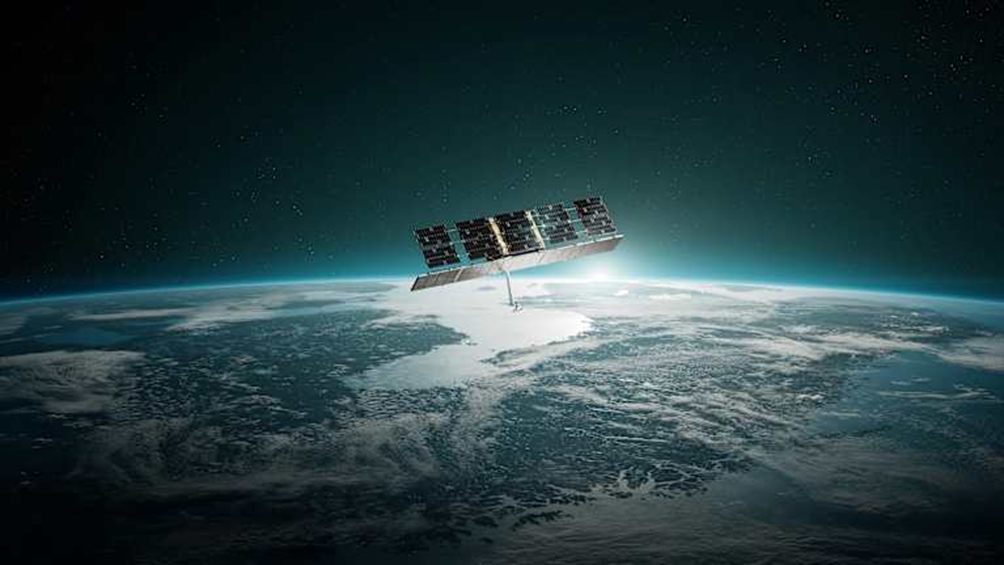
Illustration of ICEYE’s satellite over Scandinavia. Image source: ICEYE.
Sources and links
Space Strategy 2030. Publications of the Finnish Government 2025:8:
http://urn.fi/URN:ISBN:978-952-383-904-5
Government Defence Report. Publications of the Ministry of Defence 2024:7:
http://urn.fi/URN:ISBN:978-951-663-471-8
European Space Agency (ESA):
http://spacefinland.fi/euroopan-avaruusjarjesto-esa/