
Proliferation and current state of nuclear weapons
Published June 2026
- The beginning of the nuclear arms race: U.S. nuclear bombs on Hiroshima and Nagasaki in August 1945
- Soviet nuclear explosion in 1949
- The United States hydrogen bomb test in 1952
- Soviet hydrogen bomb in 1953, giant hydrogen bomb explosion in 1961
- British nuclear bomb in 1952 and hydrogen bomb in 1957
- The French nuclear bomb in 1960 and hydrogen bomb in 1968
- China’s nuclear bomb in 1964 and hydrogen bomb in 1967
- Israel’s nuclear capabilities in the 1960s
- Indian nuclear bomb 1974
- Pakistan nuclear bomb 1998
- Threshold country: Iran, possible nuclear weapons program
- Suspended nuclear weapons programs
- Sweden’s nuclear weapons programme in the 1950s and 1960s
- South Africa’s nuclear weapons programme in the 1980s
- Nuclear tests
Read more
The bombing of the cities of Hiroshima and Nagasaki by the United States with 15–20 kiloton nuclear bombs in August 1945 ushered in the nuclear era. Soon after, the Cold War between the Western powers and the Soviet Union began, with the United States and its allies on one side and the Soviet Union and its so-called satellite states on the other. The Cold War was a great power competition and a struggle for world domination, and thus, the acquisition of nuclear weapons played a major role. Nuclear weapons, intended for warfare and winning war, gained increasing political importance as instruments of foreign and security policy. The possession of nuclear weapons became a hallmark of superpower status, or at least, a sign that a country was powerful enough to command serious attention and influence in international politics.
The Soviet Union also wanted its own nuclear weapons and managed to obtain enough information about the nuclear weapons of the United States through espionage. As early as 1949, the Soviet Union was able to detonate its first nuclear device, which was a copy of the US nuclear weapon. Soon, the nuclear arms race accelerated out of control, even though attempts were made to curb it, such as mediation through the United Nations.
The United States continued to develop nuclear weapons in an effort to increase their destructive power. A major breakthrough was the development of fusion technology, which led to the hydrogen bomb. The United States detonated its first hydrogen bomb in 1952, but the Soviet Union followed suit and managed to detonate its own hydrogen bomb the following year in 1953. In the Soviet Union, hydrogen bombs continued to be developed to be increasingly powerful, culminating in 1961 when the most powerful nuclear device of all time, the 50-megaton hydrogen bomb “Tsar-bomba”, was detonated on the island of Novaya Zemlya in the Arctic. The bomb, which was eight meters long and two meters wide, weighed 27 tons. The Soviet Union sought to demonstrate its military strength to the United States. The explosion was approximately 1,570 times more powerful than the American atomic bombs dropped on Hiroshima and Nagasaki. In the late 1970s, the Soviet Union installed a 25-megaton nuclear warhead on an intercontinental missile (R-36UTTh, NATO name SS-18 Satan), which had a range of up to 16,000 kilometres. The United States also equipped some of its intercontinental missiles with megaton-class warheads, although these were generally less powerful than their Soviet counterparts.
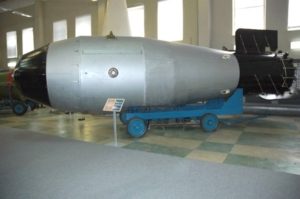
The shell of the Tsar-bomba hydrogen bomb detonated by the Soviet Union in 1961 at the Sarov Nuclear Weapons Museum in Russia. Image source: commons.wikimedia.org – Croquant with modifications by User:Hex – Oma teos, CC BY-SA 3.0.
Soon after the completion of the nuclear weapons of the United States and the Soviet Union, Britain also began to develop its own nuclear programme, partly with assistance from the United States. The first nuclear device was detonated in 1952 in Australia. It subsequently developed a hydrogen bomb, which was successfully tested in the Pacific Ocean in 1957, making Britain the third country to acquire thermonuclear weapons. France soon followed. It conducted its first nuclear test in Algeria, then a French colony, in 1960 and successfully detonated a hydrogen bomb in 1968 in French Polynesia in the Pacific Ocean.
China wanted to become a nuclear power already in the 1950s because the United States had nuclear weapons. At first, China received nuclear technology from the Soviet Union, but that cooperation ended when the two countries broke off in 1960. China continued to develop nuclear weapons on its own, and the first nuclear test was carried out in 1964 in Sinkiang (now Xinjiang Uyghur Region), and the first hydrogen bomb was detonated in 1967. From the very beginning, China defined its nuclear weapons policy as “No First Use”. Another goal, announced early on, was that China should only keep the number of its nuclear weapons at a level that would have a deterrent effect on a possible aggressor. China has generally resisted international nuclear disarmament initiatives, arguing that its arsenal remains much smaller than those of the United States and the Soviet Union (later Russia). Since the early 2000s, China has undertaken a significant modernisation and expansion of its nuclear forces.
Israel, which has faced security threats from neighbouring Muslim countries throughout much of its independence, is widely believed to have acquired a nuclear weapons capability during the 1960s. It is generally regarded as maintaining a credible nuclear deterrent, although part of Israel’s nuclear weapons policy is that it does not admit or deny that it owns nuclear weapons. It has not joined the International Treaty on the Non-Proliferation of Nuclear Weapons (NPT), and Israel has signed the Nuclear Test Ban Treaty (CTBT) but has not ratified it. Israel is considered a de facto nuclear-weapon state.
India joined the ranks of nuclear-armed states when it conducted its first nuclear test in 1974. The development of India’s nuclear programme was influenced by several factors, including China’s successful nuclear test in 1964, which was viewed as a security threat, and the rivalry with Pakistan, highlighted by the 1971 Indo-Pakistani War.
Following India’s acquisition of a nuclear weapons capability, Pakistan intensified its own nuclear programme. Pakistan detonated its first nuclear device in 1998 and received nuclear technology and know-how from China.
The North Korean dictatorship claims to have developed a nuclear weapon. According to Western estimates, it has a few nuclear warheads ready, but at least for the time being, it is not yet capable of delivering them to a target far away.
Iran has been suspected of trying to build nuclear weapons for years, but international opposition has been strong, with sanctions that have severely affected the country’s economy. The United States and Israel have also used military force in an effort to destroy Iran’s nuclear weapons program. Israel considers Iran and its possible nuclear capabilities to be an existential threat and has therefore been prepared to take any measures necessary to prevent Iran from obtaining nuclear weapons.
In recent years, international tensions have increased as a result of rapid and dramatic changes in the security environment. It has also given rise to debate on nuclear weapons policy, which was relatively limited since the Cold War. In recent years, international debate, has increasingly focused on whether some non-nuclear-weapon states should develop their own nuclear deterrents.
Among some allies of the United States, confidence in long-standing security guarantees has weakened. In particular, questions have been raised about the credibility of the United States’ extended deterrence commitments, commonly referred to as the American “nuclear umbrella,” which underpins the security of many NATO members and other allies. In Europe, there has been debate about “strategic autonomy” and Europe’s own nuclear deterrence, possibly as part of NATO’s overall deterrence.
The figure below shows the 2025 estimate of the number of nuclear weapons (nuclear warheads and bombs) in the five official nuclear weapons states (the United States, Russia, China, Britain, and France), as well as in Israel, India, Pakistan, and North Korea.
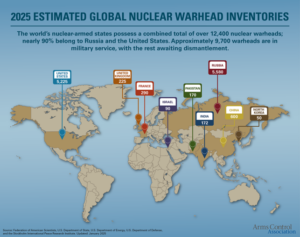
2025 estimate of the world’s nuclear weapons. Image source: Arms Control Association. https://www.armscontrol.org/factsheets/nuclear-weapons-who-has-what-glance
Suspended nuclear weapons programs
The uncontrolled proliferation of nuclear weapons seemed inevitable, especially in the 1960s. However, there are at least two examples of countries that have had a serious and advanced nuclear weapons programme but have abandoned them.
Shortly after World War II, Sweden began a secret nuclear weapons program due to the growing threat from the Soviet Union. At the end of the 1950s, it was publicly referred to as nuclear research activities, the purpose of which was to develop means of protection against the threat of nuclear weapons. The project was actively promoted in the 1960s. As international pressure against nuclear proliferation increased, the Nuclear Non-Proliferation Treaty (NPT) was established in 1968, and it aimed at preventing the proliferation of nuclear weapons. Sweden decided to join it for political and economic reasons, and as such, the nuclear weapons program was phased out by 1972. Not a single nuclear bomb was built. However, research related to nuclear weapons has continued, ensuring that expertise and technical knowledge in the field have been maintained at a high level.
Another country that has abandoned its nuclear weapons program is South Africa. Their program began with the construction of the first nuclear power plant in the mid-1960s with U.S. support but turned into a nuclear weapons program in the early 1980s. South Africa did not sign the NPT treaty. By the end of the 1980s, six nuclear warheads had been built during the secret nuclear weapons programme, and a ballistic missile was being developed at the same time. The acquisition of nuclear weapons and missiles is believed to have been motivated by the goal of achieving an internationally recognised position despite the apartheid policy. In addition, there was a perceived threat from neighbouring countries, such as Mozambique and Angola, which had gained independence in 1975, but soon after drifted into internal unrest involving communists armed by the Soviet Union. In 1991, South Africa ended its nuclear weapons program and closed its nuclear test site and uranium enrichment plant and joined the NPT treaty. Following the decision to end the nuclear weapons program, the completed nuclear warheads were dismantled. The decision coincided with the change of government from the apartheid system to the pro-communist ANC party. It has been speculated that the white regime, which was forced to relinquish power, wanted to avoid nuclear weapons ending up in the hands of the new ANC regime and possibly Cuba, Iran, Libya, or the Palestine Liberation Organization (PLO).
Sources and links
Soviet Hydrogen Bomb Program. Atomic Heritage Foundation:
https://ahf.nuclearmuseum.org/ahf/history/soviet-hydrogen-bomb-program/
Swedish nuclear weapons program. Wikipedia:
https://en.wikipedia.org/wiki/Swedish_nuclear_weapons_program
South Africa:
Why Countries Acquire and Abandon Nuclear Bombs. Council on Foreign Relations: https://education.cfr.org/learn/reading/south-africa-why-countries-acquire-and-abandon-nuclear-bombs
Nuclear Almanac. Atomic Archive.com:
https://www.atomicarchive.com/almanac/index.html
Nuclear Weapons: Who Has What at a Glance. Arms Control Association, March 2026:
https://www.armscontrol.org/factsheets/nuclear-weapons-who-has-what-glance
Status of World Nuclear Forces. Federation of American Scientists:
https://fas.org/initiative/status-world-nuclear-forces/
Nuclear Weapons: Who Has What at a Glance. Arms Control Association:
https://www.armscontrol.org/factsheets/nuclear-weapons-who-has-what-glance