
Security situation in Northern Europe
Updated December 2025
- Russia:
- The growing military and economic importance of the Arctic area,
- The strategic importance of the Baltic Sea for oil exports,
- Military build-up in response to Finland and Sweden’s NATO membership,
- The gradual opening of the Northeast Passage (Northern Sea Route) due to global warming.
- NATO’s growing importance in the Nordic region:
- The Nordic and Baltic countries, Poland, and Germany strengthening their defences,
- S. Defense Cooperation Agreements (DCAs) with NATO countries in the Baltic Sea region,
- NATO troops in Poland, the Baltic States, and soon also in Finland,
- The defence of the Baltic States relies heavily on NATO support.
- The Arctic Ocean is increasingly important for Norway:
- Large energy reserves in the Norwegian Economic Zone,
- The focus of Norway’s defence is in the north.
- Svalbard’s sensitive position.
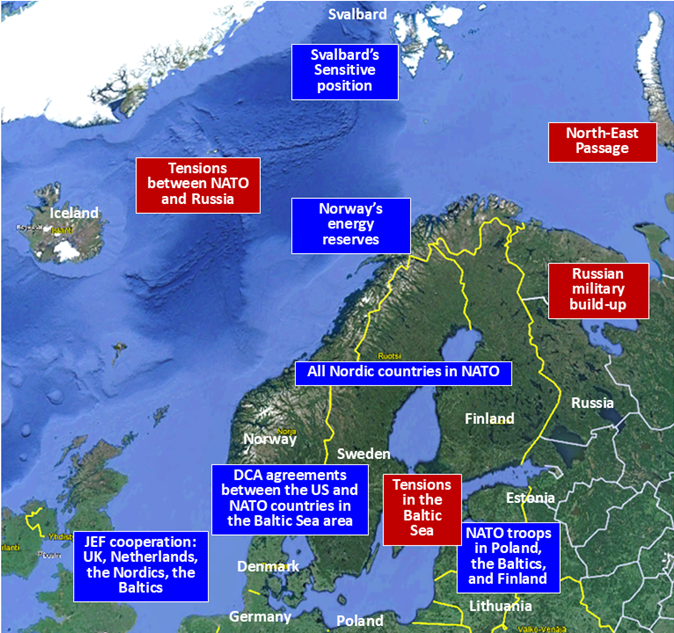
Security situation in Northern Europe. Source Nikolai Ylirotu
Read more
The security situation in Northern Europe is most affected by Russia’s actions and strategic interests. Its most strategically important areas – Moscow, St. Petersburg, the Kola Peninsula, and Kaliningrad – are located in the vicinity of Finland. For Russia, key issues include the strategic military capabilities concentrated on the Kola Peninsula, unrestricted access to the Atlantic, and the control and development of the Arctic region.
Finland and Sweden’s NATO memberships have weakened Russia’s strategic position in the Baltic Sea region and in the North. Russia is expected to strengthen its military presence and actions on its Western and Northwestern borders, if this is possible, depending on the course of the war in Ukraine and its availability of resources. Russia seeks to strengthen its position as a great power and divide spheres of influence while trying to dismantle the unity of the West. It is also seeking to increase its influence through military force, as evidenced by the full-scale war against Ukraine. Russia’s hostile hybrid actions, including those of sabotage, have targeted Europe widely. According to the Finnish Government’s Defence Report (2024), Russia could quickly launch long-term military pressure, and its actions create instability in Finland’s neighbouring areas. Russia is considered the most significant threat to the security of NATO countries. The aim is to control the threat through NATO’s collective deterrence and defence capabilities.
The defence cooperation agreements (DCAs) signed by the Nordic countries with the United States will change the strategic constellation in Northern Europe. The DCA agreement with Finland enables the training of American troops and the storage of weapons and materiel in Finland. The Arctic land area and airspace controlled by NATO countries have expanded, and this will be taken into consideration in NATO’s joint planning and operations. This will create a stronger deterrence in Northern Europe, which will contribute to balancing Russia’s military power in the Northern regions.
Sources and links
Government’s Defence Report (2024):
http://urn.fi/URN:ISBN:978-952-383-852-9
Government Report on Finnish Foreign and Security Policy (2024):
http://urn.fi/URN:ISBN:978-952-383-929-8
Finnish Military Intelligence Review 2025:
https://puolustusvoimat.fi/documents/1948673/2014902/PV_sotilastiedustelu_raportti_EN_2025_web.pdf/c0125ed9-1467-23e7-e7b6-a7891c4fb5fe/PV_sotilastiedustelu_raportti_EN_2025_web.pdf?t=1737033107374