
Security political significance of the Arctic region
Updated December 2025
Climate change is reducing Arctic glaciers and sea ice
- Arctic sea routes will open within 10–20 years.
- The area is rich in untapped natural resources.
- The economic and military interests of the states bordering the Arctic Ocean.
- The military activity of the great powers in the Arctic is increasing.
- Actors outside the region are interested in sea routes and natural resources.
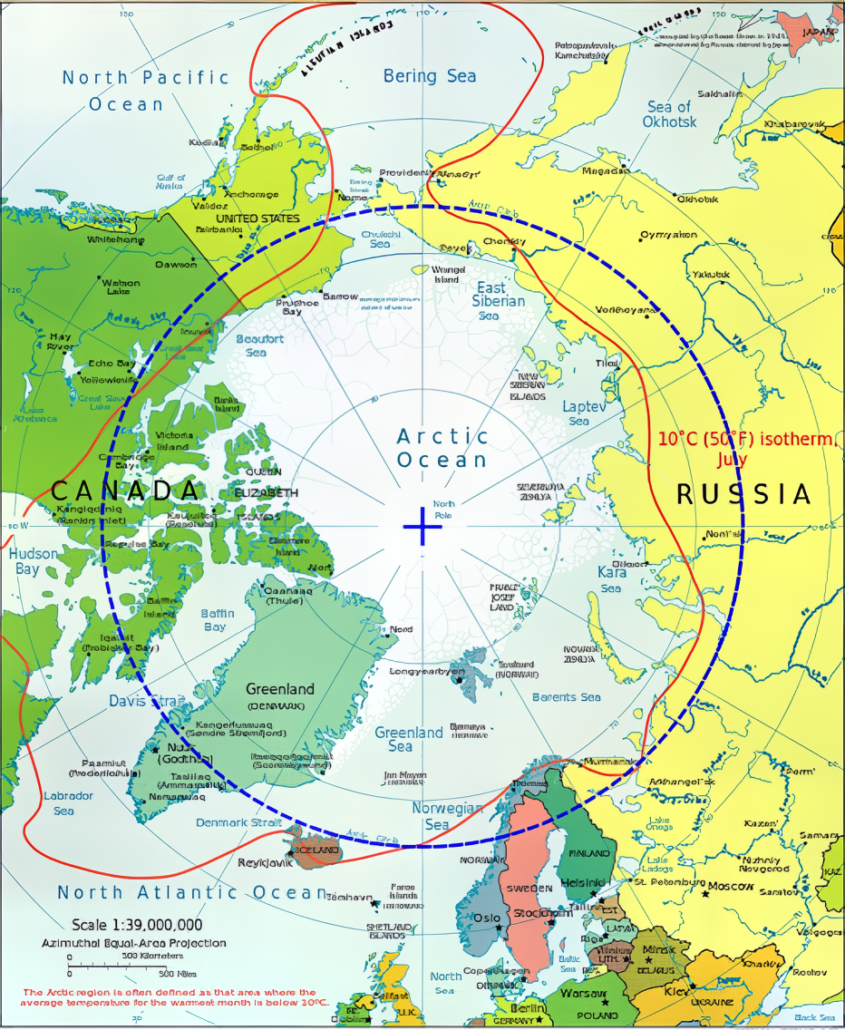
Arctic region. The Arctic Circle in blue. Temperature limit (10°C) in red. Image source: commons.wikimedia.org, Public Domain
Read more
Arctic region and states
The Arctic usually refers to the Arctic region north of the Arctic Circle, and the Arctic states comprise those countries that extend north of the Arctic Circle (Russia, the United States, Canada, Norway, Denmark (through Greenland), Iceland, Sweden and Finland). These are member states of the Arctic Council. Another definition of the Arctic is based on temperatures: it is the region where the average temperature in the warmest month of the year is less than +10°C. Both boundaries are marked on the attached map.
Security policy disputes have not so far affected the Arctic significantly, due, for example, to the harsh conditions in the region. However, the situation is changing because of climate change. Warmer temperatures are melting the permafrost in the Arctic, as well as the ice cover of the Arctic Ocean. As a result, sea routes such as the Northeast Passage (Northern Sea Route) to the north of Russia and the Northwest Passage to the north of Canada are gradually opening. In addition, natural resources such as hydrocarbons, minerals and fish stocks that could not be profitably exploited in the past may be more easily available in the future. These factors increase global interest in the Arctic region. The new opportunities are largely in Russia’s territory or exclusive economic zone, and Russia is preparing militarily to ensure that they remain under its control. Other countries bordering the Arctic Ocean are also increasing their military capabilities in the Arctic operating environments.
More than 60 % of the total land area of the Arctic belongs to Russia, and more than 80 % of the population of the Arctic region are Russian citizens. Nearly 40 % of Canada’s territory is north of the Arctic Circle, but only 120,000 Canadian citizens live there. The United States became an Arctic state only in 1867, when it purchased Alaska from Russia. Due to climate change, the United States has also noticed that the Arctic is becoming more important.
Finland, Sweden and Norway are naturally Arctic states, as a significant part of their territory lies north of the Arctic Circle. Iceland’s northernmost tip and sea area extend north of the Arctic Circle. Denmark’s status as an Arctic state is based only on the fact that Greenland belongs to Denmark.
Climate change in the Arctic
The visible consequences of climate change in the Arctic include melting glaciers, decreasing ice cover in the Arctic Ocean and thawing permafrost, especially in the northern parts of Russia. These phenomena will open opportunities for the profitable exploitation of Arctic natural resources and the introduction of arctic sea routes within 10–20 years. The untapped oil, natural gas and mineral resources in the region are estimated to be huge, and there are also large fish reserves in the Arctic Ocean. Fish catches in northern sea areas are expected to increase, as fish stocks are moving further north because of the warming seas. Due to the difficult conditions, costs will continue to be high, which will reduce the profitable use of these natural resources.
Based on computer modelling and simulations, it has been estimated that, by the 2040s, both the Northeast Passage and the Northwest Passage will be used for maritime traffic during the summer seasons without icebreaker assistance. In the second half of the century, the route directly through the North Pole is predicted to become the shortest northern sea route.
Arctic sea routes have the potential to significantly shorten sea journeys between Europe and Asia and between the Atlantic and Pacific Oceans. However, merchant shipping on routes measuring thousands of kilometres will need intermediate ports and other support, which will likely be scarce for many years to come. Maritime conditions will also remain difficult for a long time, even in the summer season, because of the pack ice, fog and storms prevalent in the Arctic Ocean. Because of the risks, insurance premiums are and will remain high. The use of commercial maritime transport connections also involves transport and timetable reliability. As long as the conditions on the Arctic sea routes are uncertain, large-scale commercial maritime transport cannot be started. The Northeast Passage is used to some extent along the coast of Siberia for local traffic. State actors are not subject to the restrictions described above, as their starting points and requirements differ and are based on military needs and operational considerations.
The use of Arctic natural resources, such as oil and natural gas deposits, is affected by the ongoing energy transition. Efforts are being made to significantly reduce the use of fossil energy sources and to switch to renewable forms of energy. This will decrease the need to exploit oil and natural gas deposits available in the Arctic region. In addition to the physical constraints described above, the use of the opening northern sea routes is affected by the global political situation, including extensive international sanctions against Russia due to the war in Ukraine.
Read more in the menu Security impacts of climate change (link)
Arctic Council
The Arctic Council is a co-operation body of Arctic states whose members are Russia, the United States, Canada and all the Nordic countries. Indigenous peoples’ organisations have a permanent right to participate in the meetings of the Arctic Council. In addition, 38 observers have the right to attend the meetings, 13 of whom represent non-Arctic states (major European countries, as well as China, Japan, South Korea and India), and others of whom represent various international and nature conservation organisations. As three EU countries are members of the Arctic Council, the EU also has an interest in the region and has sought to become an observer in the Arctic Council. This requires the consent of the permanent member states, and some members oppose it.
The aim has been to keep the Arctic Council as a non-political cooperation body that does not deal with security policy or military matters, on which member states disagree. When Russia launched a full-scale war against Ukraine in February 2022, the Western members of the Arctic Council announced that they would boycott the Council’s activities until further notice, leaving the Council paralysed.
Economic and military interest in the Arctic is growing
Attractive economic prospects and new opportunities have increased interest in the Arctic regions, despite the difficult conditions. The ownership of the continental shelves, the seabed and the sea area of the Arctic Ocean has not yet been determined, because there has been no need for it. But the situation is changing. The countries bordering the Arctic Ocean have extended their exclusive economic zones in the Arctic Ocean and made their sometimes-conflicting ownership claims to the sea area on the basis of the UN Convention on the Law of the Sea. For example, the demands made by Russia and Denmark concerning the underwater Lomonosov Ridge overlap to some extent in the North Pole region. There is also overlap in the demands of Canada and Russia. The control of the central parts of the Arctic Ocean will remain undetermined as long as the UN-led process is ongoing (it has already lasted for more than 20 years).
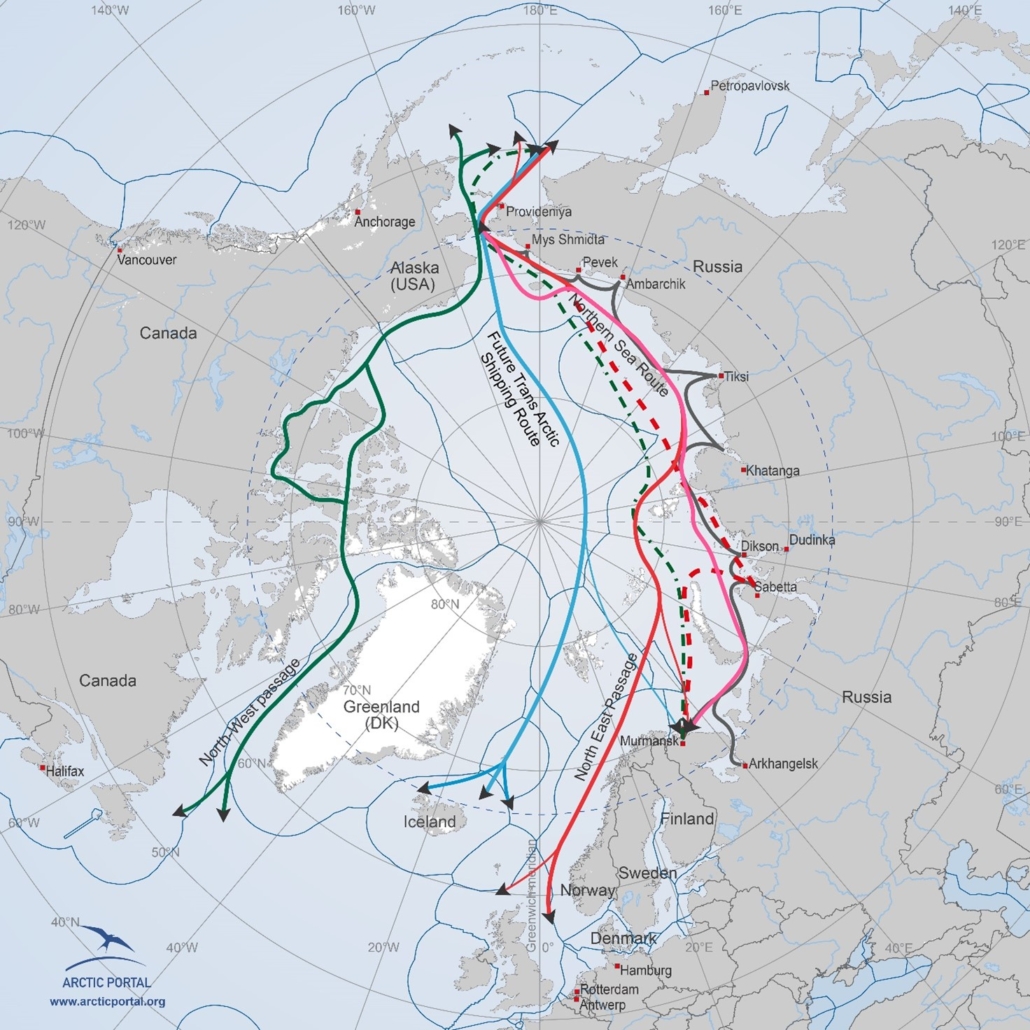
Current and future sea routes in the Arctic. Image source: www.arcticportal.org
The Northeast Passage and the Northwest Passage are the shortest sea routes between Asia and Europe. The Northeast Passage lies mostly in Russia’s Northern Economic Zone. Russia requires foreign vessels to give at least 45 days’ advance notice and to use a Russian pilot throughout the voyage. Canada regards the Northwest Passage as located in its internal waters, and foreign vessels must at least give advance notice to the Canadian authorities or even request permission to use it. The US, the EU and China do not recognise Canada’s and Russia’s claims.
China is interested in the natural resources and other economic interests of the Arctic. It sees the Northeast Passage as part of its global transport connections to different parts of the world. China claims to be a “near Arctic” country and has sought membership of the Arctic Council but has had to settle for observer status. Russia has offered to cooperate with China in the development of the Northeast Passage.
For decades, the Arctic has been important for the major powers, especially in terms of nuclear deterrence and strategic early warning systems. Both US and Soviet/Russian submarines have long been operating in the Arctic Ocean, including under the polar ice. The majority of Russia’s strategic nuclear deterrent lies in the Arctic at bases in Murmansk and the Kola Peninsula, and military activity has consequently increased in the Arctic in recent years.

Russian nuclear-powered icebreaker 50 Let Pobedy. Image source: commons.wikimedia.org By Kiselev d – Own work, CC BY-SA 3.0
The military significance of the north for Russia is great and still growing. It has a northern coastline thousands of kilometres long, which, due to climate change, is gradually freeing itself from ice. Russia has the most effective military capability in Arctic conditions, for example, the world’s largest fleet of icebreakers. For the last 15 years, it has been renovating military bases, airports and ports in its northern coastal areas, and has also been building completely new bases. Russia intensifies its territorial surveillance and seeks to ensure that its military superiority in the Arctic is maintained.
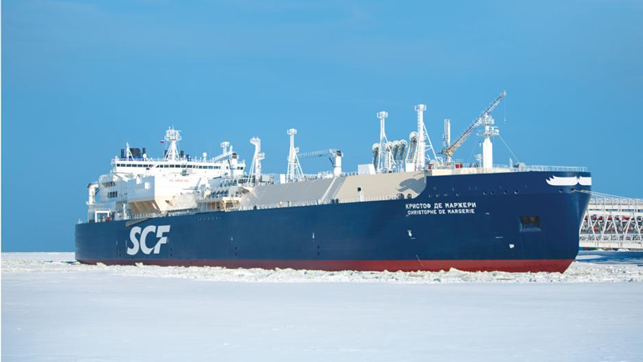
The Russian ice-strengthened LNG tanker Christophe de Margerie was the first to transport LNG cargo from Norway via the Northern Sea Route to South Korea without icebreaker assistance in August 2017. The trip took about three weeks. The southern route would have taken a month. Image source: High North News.
Russia’s military build-up in the Arctic worries Arctic NATO countries, whose own military capability in the region is clearly weaker in comparison. The Arctic region, especially its northernmost parts, has been a remote and difficult operating environment for NATO. However, due to changing physical conditions in the region and shifting geopolitical factors, NATO is expected to increase its interest in the entire region. Due to the perceived threat, the NATO countries in the Arctic region are strengthening their military capabilities in the north. Since Finland and Sweden joined NATO, two new Arctic member states have joined the Alliance’s northern flank, bringing diverse experience and expertise in military operations in cold conditions. NATO’s interest in the Arctic is expected to increase as a result of Finland and Sweden’s NATO membership.
Although the United States has been slow to react to the consequences of climate change and the growing importance of the Arctic, it has acknowledged that the security threat to the north will increase as the protective ice cover decreases and weapons technology advances. China is also seen as a growing threat in the Arctic.
The United States’ Arctic military capability is primarily based on its Air Force, as the surface ships of the Navy, for example, are unable to operate in icy conditions, and there are only two aging icebreakers. However, a major new icebreaker construction program is about to begin. The United States is also seeking to increase the presence and operational capability of all its services in Alaska. Together with its NATO allies, it has organised large-scale military exercises in the northern sea areas. In the Arctic region, the United States can rely on the infrastructure and bases of its NATO allies.
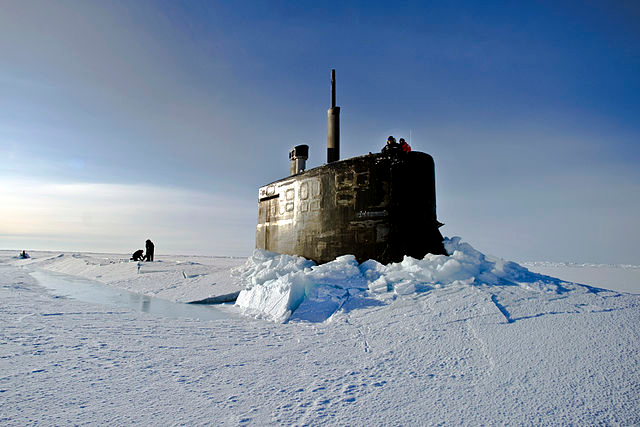
Of the US naval warships, only submarines are capable of operating in icy conditions. USS Connecticut during ICEX exercise in the Arctic Ocean in 2011. Image source: Commons.wikimedia.org, Defense.gov News Photo, Public domain.
Sources and links
Granholm, Niklas – Carlsson, Märta – Korkmaz, Kaan: The Big Three in the Arctic. China’s, Russia’s and the United States’ strategies for the new Arctic. FOI report FOI-R–4296—SE, 11.11.2016.
https://www.foi.se/rest-api/report/FOI-R–4296–SE
Mikkola, Harri – Paukkunen, Samu – Toveri, Pekka: Russian Aggression and the European Arctic. Avoiding the Trap of Arctic Exceptionalism. FIIA Briefing Paper 359, April 2023.
https://www.fiia.fi/wp-content/uploads/2023/04/bp359_russian-aggression-and-the-european-arctic_harri-mikkola-samu-paukkunen-pekka-toveri.pdf
Stratfor 23.2.2021: Increased Arctic Activity Sets the Stage for U.S.-Russia Competition. https://worldview.stratfor.com/article/increased-arctic-activity-sets-stage-us-russia-competition
Wezeman, Siemon T.: Military Capabilities in the Arctic: A New Cold War in the High North? SIPRI, October 2016.
www.sipri.org/sites/default/files/Military-capabilities-in-the-Arctic.pdf