
Limitation of nuclear weapons
Published June 2026
- The number of nuclear weapons at its highest exceeded 70,000
- The Outer Space Treaty 1967
- The Treaty on the Non-Proliferation of Nuclear Weapons (NPT) of 1968
- SALT agreements in the 1960s and 1970s
- The INF Treaty 1988
- The Nuclear Test Ban Treaty 1996
- START agreements in the 1990s and 2010s
- The Treaty on the Prohibition of Nuclear Weapons 2017
Read more
As the number of nuclear weapons and the number of states possessing them grew uncontrollably, it became evident that international rules and restrictive measures were needed. The number of nuclear weapons in the world was at its highest during the Cold War in 1986, when there were more than 70,300 nuclear weapons. The numbers developed at different rates in different countries. In the United States, the number of nuclear weapons peaked at more than 31,200 in 1967 and gradually began to decline thereafter. The Soviet Union had the most nuclear weapons in 1986, with over 40,000 weapons.
From 1986 onwards, the effects of nuclear arms control and disarmament agreements became increasingly evident, as the total number of nuclear weapons held by the superpowers began to decline significantly. In the early 2000s, both the United States and Russia possessed just over 10,000 nuclear weapons each. By around 2016, their arsenals had been reduced to fewer than 5,000 nuclear weapons per country. The nuclear arsenals of other nuclear-weapon states have remained comparatively small and have had limited impact on overall global stockpiles. As a result, the global distribution of nuclear weapons continues to be heavily dominated by the United States and Russia. The current global stockpile of nuclear weapons is just over 12,000.
The Outer Space Treaty 1967
In 1967, the United Nations’ so-called Outer Space Treaty was signed and entered into force. It prohibits nuclear weapons and other weapons of mass destruction in space. All nuclear-weapon states are parties to the treaty. It also prohibits the placement of nuclear weapons or other weapons of mass destruction in outer space, as well as the establishment of military bases on celestial bodies. However, it does not prohibit all military activity in space.
The Treaty on the Non-Proliferation of Nuclear Weapons (NPT) of 1968
At the beginning of the 1960s, the proliferation of nuclear weapons was already uncontrollable, and more than 20 states were planning to acquire their own nuclear weapons. To halt its development, a comprehensive international treaty on the non-proliferation of nuclear weapons (NPT) was reached, which was signed in 1968 and entered into force in 1970. The aim of the treaty is to prevent the proliferation of nuclear weapons and nuclear technology, to promote cooperation in the peaceful use of nuclear energy, and to promote general and complete nuclear disarmament. The NPT is the only binding multilateral treaty aimed at the disarmament of nuclear-weapon states. A total of 191 countries are parties to the treaty, including all officially recognised nuclear-weapon states. North Korea announced its withdrawal from the NPT in 2003 and has since developed some level of nuclear weapons despite international opposition and sanctions.
The text of the NPT treaty was negotiated in a way that it accommodates the arrangements for nuclear burden-sharing among NATO member states. The aim was to prevent NATO’s non-nuclear weapon countries from acquiring their own nuclear weapons. The same goal was also served by the security guarantees included in NATO membership, which included a “nuclear umbrella” from the United States. Thanks to NATO’s arrangements, the non-nuclear member states did not consider it necessary to acquire their own nuclear weapons. A key aspect of NATO’s nuclear burden-sharing arrangement is that NATO’s nuclear deterrence includes nuclear weapons deployed by the United States in Europe, which remain under strict operational control of the United States.
SALT agreements in the 1960s and 1970s
In 1968, the Soviet Union and the United States began negotiations to limit the number of their nuclear weapons, as the unrestricted nuclear arms race was costly for both. The SALT negotiations (Strategic Arms Limitation Talks) were first held in Helsinki in 1968 and then alternated between Vienna and Helsinki. As a result of years of negotiations, the SALT I Treaty, signed in Moscow in 1972, and the related Anti-Ballistic Missile Treaty (ABM), which limited anti-ballistic missile systems, were concluded.
After the agreement, negotiations continued with the aim of limiting the use of multi-warhead missiles and cruise missiles. The treaty known as SALT II was signed in 1979, but it never came into force because it was not ratified by the United States Senate. This was due to the presence of Soviet troops in Cuba and the Soviet Union’s invasion of Afghanistan in December 1979. The agreement expired in 1985, although both parties complied with its provisions until its expiration.
INF Treaty 1988
The Intermediate-Range Nuclear Forces Treaty (INF) was signed by the United States and the Soviet Union in 1987 and ratified by both sides on 1 June 1988. It banned short- and medium-range (500–5500 km) ground-based ballistic and cruise missiles deployed by both sides in Europe. These missiles were to be destroyed within three years, by 1 June 1991. The treaty included detailed verification measures. It prohibited missiles in this range regardless of the type of warhead but did not apply to aircraft-based or ship-based nuclear weapons, such as nuclear warhead-armed cruise missiles placed on U.S. warships. The nuclear forces of France and the United Kingdom were not covered because those countries were not parties to the treaty.
The treaty was created in response to the large-scale deployment of ground-based short- and intermediate-range nuclear missiles by both the Soviet Union and the Warsaw Pact, and the United States and NATO, in Central Europe during the 1970s and 1980s. These missiles were intended to strike targets within Europe. The best-known missile systems covered by the treaty were the Soviet RSD-10 (NATO name: SS-20 Saber) and the American Pershing II. This development led to large-scale demonstrations, especially in Western European countries, against NATO’s “Euro-missiles”. No comparable public protest movement against Soviet missile deployments emerged on the other side of the Iron Curtain, i.e., in the Warsaw Pact countries.
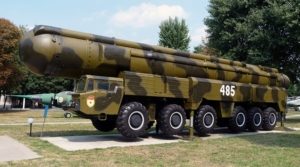
Ballistic medium-range nuclear warhead missile RSD-10 (NATO name SS-20 Saber) in a museum in Ukraine. Image source: commons.wikimedia.org By George Chernilevsky – Own work, Public Domain.
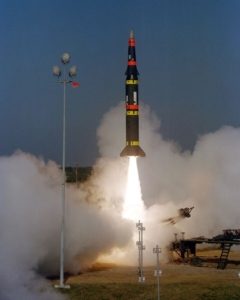
Pershing II intermediate-range ballistic missile in test launch. Image source: https://commons.wikimedia.org By DoD – Public Domain.
The treaty remained in force even after the collapse of the Soviet Union and the Warsaw Pact. In 2007, Russia threatened to withdraw from the treaty if it was not extended to other countries. China, India, and Pakistan, for example, possessed medium-range missiles, while Iran and North Korea were also developing similar capabilities. Earlier, Russia had withdrawn from the extensive Conventional Armed Forces in Europe (CFE) Treaty, which limited the number of conventional weapons in Europe. The INF Treaty did not expire until 2019, when the United States withdrew from it, accusing Russia of violating the treaty. Russia then also withdrew from the treaty and announced its intention to start developing ground-based medium-range missiles, i.e., the very type of weapons prohibited by the INF Treaty.
From the perspective of European security, the INF treaty played a very important role in reducing the risk of war during the final stages of the Cold War. It also contributed to easing East–West tensions and helped create the conditions for the end of the Cold War. The treaty’s collapse was widely seen as a major setback for arms control and further contributed to increased tensions between Russia and the West.
The Nuclear Test Ban Treaty 1996
All nuclear tests worldwide were prohibited by the Comprehensive Nuclear Test Ban Treaty (CTBT) in 1996. The agreement also includes a comprehensive verification system to ensure compliance. The treaty has been signed by 187 countries, but the United States, Russia, China, Israel, Iran, and Egypt have not ratified it, so the treaty is not yet in force. India, Pakistan, and North Korea have not signed the treaty and have also carried out a few nuclear tests. Although the treaty never entered into force, the number of nuclear tests decreased significantly after it was signed.
START agreements in the 1990s and 2010s
The SALT Treaty negotiations led to the creation of the Strategic Arms Reduction Treaty (START) between the United States and the Soviet Union. The significant treaty was signed in the summer of 1991, but soon after, the Soviet Union collapsed. The treaty finally entered into force in 1994, when it was signed by the United States and Russia, Belarus, Ukraine, and Kazakhstan, all of which had nuclear weapons from the former Soviet Union on their territory. The agreement limited each side to 6,000 operational strategic nuclear warheads and no more than 1,600 intercontinental ballistic missiles (ICBMs) and strategic bombers capable of delivering warheads. The START I Treaty is widely regarded as the most extensive and complex arms control agreement in history. As a result of its implementation, approximately 80 % of the world’s strategic nuclear weapons at the time were eliminated. The treaty remained in force until 2009.
The START II Treaty, signed by the United States and Russia in 1993, was intended to complement START I. It prohibited the equipping of intercontinental ballistic missiles with multiple independently targetable re-entry vehicles (MIRVs), which allow a single missile to strike several different targets. However, the treaty never entered into force due to disagreements over ratifications. Both sides had, and continue to possess, multi-warhead ICBM missiles.
The START III treaty, which was intended to be the next step in nuclear disarmament in the late 1990s, came to nothing, and it was not possible to negotiate the treaty properly due to growing disagreements between the United States and Russia.
However, the United States and Russia reached an agreement on the limitation of strategic offensive weapons in the form of the so-called SORT (Strategic Offensive Reductions Treaty), which was signed in 2002. In the agreement, the parties committed to reducing the number of nuclear warheads in operational use to 1,700–2,200. The agreement entered into force in 2003, and remained in force until 2012, but expired with the New START Treaty in 2011.
After the expiry of the START I treaty in 2009, the United States and Russia conducted new negotiations on the limitation of their nuclear weapons. As a result, a follow-up agreement called New START was born in 2010, and it entered into force after ratifications in 2011. The agreement was made for ten years, and in 2021, it was extended by five years. In 2023, Russia announced that it would stop complying with the agreement, and the agreement expired on 5 February 2026.
Under the New START treaty, each side was allowed up to 700 operational strategic nuclear weapon delivery vehicles, including intercontinental land-based and submarine-launched intercontinental ballistic missiles and strategic bombers. The treaty limited each side to 1,550 deployed strategic nuclear warheads. These restrictions were greater than in any previous nuclear arms limitation treaty. However, the treaty did not restrict the number of nuclear weapons held in reserves or storage, which was an important consideration as Russia had significantly larger stockpiles than the United States. The treaty also included a verification mechanism, granting both parties the right to inspect each other’s nuclear weapons, missiles, and launchers to ensure compliance.
The expiry of the treaty was considered a worrying development internationally because it removed the last remaining limits on the nuclear arsenals of the United States and Russia. There have been fears that a new nuclear arms race will begin. A comparable situation last existed during the Cold War, when the global nuclear arsenal exceeded 70,000 warheads. Since the end of the treaty’s restrictions, the number of ready-to-use strategic nuclear warheads and nuclear bombs in both the United States and Russia has already exceeded the limits set under the New START Treaty. Moreover, as China strengthens its nuclear deterrence, it is predicted that a new global nuclear arms race will begin, similar to that of the Cold War era.
Treaty on the Prohibition of Nuclear Weapons 2017
The Treaty on the Prohibition of Nuclear Weapons (TPNW) was adopted by the international conference mandated by the General Assembly of the UN in 2017, and it entered into force after ratification by 50 countries in 2021. The Convention has been signed by 95 countries and ratified by 74 since then. The goal of the treaty is the elimination and destruction of all nuclear weapons. The treaty prohibits the development, testing, production, acquisition, possession, use, and threat of nuclear weapons. Not a single country that possesses nuclear weapons has joined the treaty. NATO countries have also opted out of the treaty because they consider it a danger to the existence of NATO’s nuclear deterrent. All NATO countries consider NATO’s nuclear deterrence to be a crucial part of their security solution – especially in the current dangerous global situation. NATO has also declared that as long as nuclear weapons exist, it will remain a nuclear alliance. Although the TPNW treaty has not reduced the world’s nuclear weapons, it has been estimated to contribute to the spread of anti-nuclear sentiment in the world and weaken their acceptability as a weapon of war.
Sources and links
Intermediate-Range Nuclear Forces Treaty 1987. Wikipedia:
https://en.wikipedia.org/wiki/Intermediate-Range_Nuclear_Forces_Treaty
Outer Space Treaty. UN Office for Outer Space Affairs:
https://www.unoosa.org/oosa/en/ourwork/spacelaw/treaties/introouterspacetreaty.html
The Treaty on the Prohibition of Nuclear Weapons At A Glance. Arms Control Association, Oct. 2025:
https://www.armscontrol.org/factsheets/treaty-prohibition-nuclear-weapons-glance