

The security impacts of climate change
Updated December 2025
Climate change
- Constitutes a widespread security threat to humans and societies
- Some of the forms of climate change emerge rapidly and cannot be predicted
- Leads to the growing phenomenon of climate refugees
- The consequences of climate change exacerbate existing conflicts
- Results in geopolitical challenges: disputes over natural resources, instability
Read more
Some of the global forms of climate change develop rapidly and can be difficult to detect. New, diverse situations may develop imperceptibly and unexpectedly. The effects of climate change can be unpredictable, escalate rapidly or occur over a long period, due to the complex mechanisms involved. The impacts on societal functions can be direct or indirect, or they may have ripple effects. It is often difficult to control spill-over effects and anticipate exposure to risks, because they are caused by complex chains of events.
As droughts increase, forest fires and wildfires become more frequent, grain yields decrease, and food shortages grow. Large areas may turn into uninhabitable deserts. The ice cover provided by continental glaciers and the Arctic Ocean is melting. In addition, thermal expansion is occurring in seawater. Together, these factors will cause sea levels to rise by up to one metre by the end of this century. This is a growing threat for coastal settlements, especially lowland settlements on all continents (Bangladesh in Asia is a compelling example). The very existence of some of the small island states located in the Pacific Ocean is in danger.

Flood in Bangladesh in 2020. Image source: unicef.org
The worst consequences of climate change are occurring in countries with rapid population growth – for example, in Africa. Climate refugees are forced to leave their homes because of the effects of climate change. The driving factors can be natural catastrophes, such as floods or storms, or a slow, but steady deterioration in living conditions. While most climate refugees move within their home countries, some go further. According to the World Bank, 140 million people have already been displaced by the consequences of climate change in Africa, Asia, and Latin America. This number is projected to grow strongly over the next 30 years.
Rising global temperatures have become an increasingly important driver for migration. According to the UN Human Rights Committee, climate refugees cannot be obliged to return to the uninhabitable conditions of their home countries. The United Nations High Commissioner for Refugees (UNHCR) affirms that they have the right to international protection. The migration of millions of people poses considerable challenges for border management, migration management and the maintenance of public order in the destination areas.
Natural disasters already cause more homelessness than violent conflicts, but the effects of climate change further exacerbate existing crises. The effects of climate change are also clearly linked to the increase in conflicts. For example, one of the root causes of the so-called Arab Spring (2011), as well as many conflicts in Africa, is the prolonged drought in the region, partly caused by global warming. Likewise, the Syrian civil war was exacerbated by an exceptional drought in the region. It complicated farming, causing people to move to cities, raising food prices, increasing tensions and leading to a large-scale exodus to Europe. Environmental changes in the Sahel region of Africa have raised tensions between farmers and nomads. When drought deprives farmers of their livelihoods, the temptation to join criminal organisations and terrorist groups becomes even more attractive.
Forest fires, storms and heavy rainfall require preparedness in rescue services and maritime search and rescue. For example, in California and Australia, large-scale wildfires are an annual phenomenon, but climate change is exacerbating droughts and intensifying the effects of fires.

Wildfires in Australia. Image source: commons.wikimedia.org, By Nick-D – Own work, CC BY-SA 4.0
The northernmost parts of the Earth are warming faster than the rest of the Earth, up to four times faster than other areas. The Arctic region is rich in natural gas, crude oil, minerals and fish reserves that have not been exploited because of harsh climatic conditions or because exploitation has previously been economically unviable. The decrease in sea ice and glaciers and the melting of permafrost will make it possible in the future to make profitable use of natural resources and to take advantage of arctic sea routes. However, the management of the Arctic Ocean’s sea areas and continental shelves and the natural resources therein is partly unresolved and thus the cause of potentially serious disputes. The growing interest of non-Arctic states in the region may increase tensions.
Read more in the menu The security political significance of the Arctic region (link)
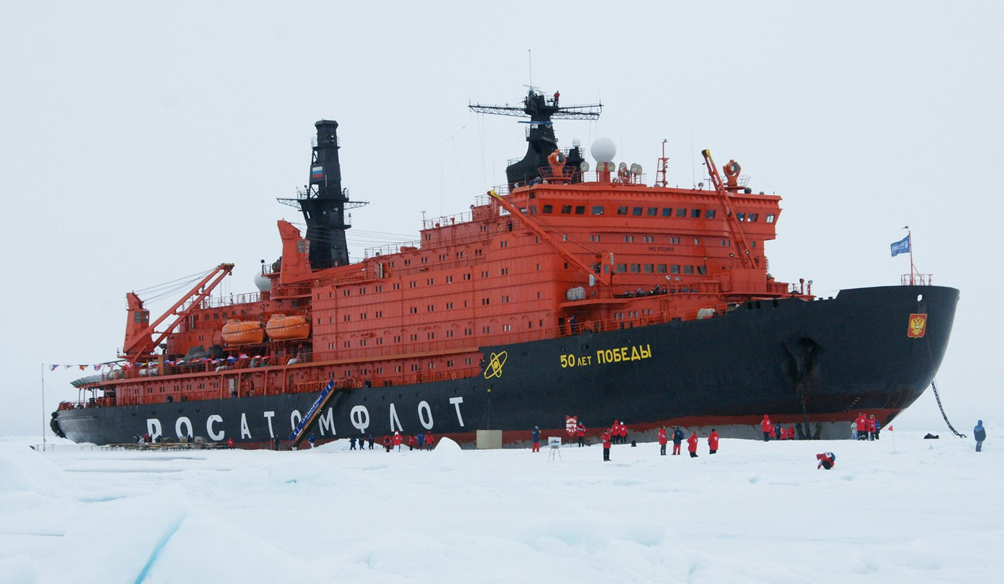
Russian nuclear-powered icebreaker 50 Let Pobedy. Image source: commons.wikimedia.org By Kiselev d – Own work, CC BY-SA 3.0
The increase in extreme weather phenomena will also have security-related consequences in developed countries such as Finland. Droughts, severe storms, heavy rainfall and floods are increasing and are threatening the critical infrastructure of societies. Global warming is also affecting primary production and the exploitation of natural resources, as well as the viability of residential areas whose economic structure is sensitive to the effects of climate change, such as coastal areas and archipelagos.
In Finland, the civil service has been assessing the risk factors caused by climate change for many years. “The National Risk Assessment 2023” published by the Ministry of the Interior identifies the main risk factors that apply to society. According to the Assessment, Finland must prepare not only for the effects of extreme weather phenomena, but also for those risks that originate outside the country’s borders. They increase the likelihood of large-scale immigration and will affect industrial operations and the security of supply, for example.
Sources and links
Climate Change & Security Impact Assessment. The Secretary General’s Report. NATO 2022. https://www.nato.int/nato_static_fl2014/assets/pdf/2022/6/pdf/280622-climate-impact-assessment.pdf
European Parliamentary Research Service: Climate change considerations for EU security and defence policy. June 2022.
http://www.europarl.europa.eu/RegData/etudes/BRIE/2022/729467/EPRS_BRI(2022)729467_EN.pdf
Hakala, Emma: Climate Security: Strategy or Necessity for Finland? FIIA Briefing Paper 209. FIIA 2016.
https://www.fiia.fi/wp-content/uploads/2017/04/bp209_climate_security.pdf
National risk assessment 2023:
http://urn.fi/URN:ISBN:978-952-324-610-2
Government report on Finnish foreign and security policy (2024):
http://urn.fi/URN:ISBN:978-952-383-929-8