
The United States in space
Updated December 2025
- The United States Space Command (USSPACECOM), Space Force (USSF) 2019
- The ability to interfere with signals to and from satellite navigation services
- Star Wars: the first steps in space warfare
- Space as a new area of warfare
- NASA is responsible for the US space program and civil aviation research
- Space tourism is a growing business sector
Read more
The United States Space Command (USSPACECOM) is the command for the US Armed Forces’ space operations and one of the 11 operational combatant commands of the Armed Forces. The US Space Force (USSF) was established in 2019 and is tasked with training and equipping the Armed Forces’ Space Forces for global space operations. The Space Force is one of six armed services and consists of 8,600 soldiers. The budget is 30 billion USD for 2024.
GPS (the Global Positioning System) is a satellite-based positioning system developed and funded by the U.S. Department of Defense, officially called Navstar GPS. The GPS satellite constellation orbits the Earth at an altitude of about 20,200 kilometres. The system provides location and time information for almost the entire world’s banking system’s payment transactions and for most of the world’s smartphones.

American GSSAP satellites. Image source: U.S. Air Force / Global counterspace capabilities: An open-source assessment, April 2020, Secure World Foundation.
The Strategic Defense Initiative (SDI) was a U.S. effort announced by President Ronald Reagan in 1983 to build a space-based missile defence system. Its purpose was to protect the United States from Soviet intercontinental ballistic nuclear weapons. The project was often dubbed “Star Wars”. The plan included mainly unmanned space stations that could destroy any ballistic missiles that had taken off into space, and to do it before their terminal phase.
So far, the United States does not have a space-based ASAT (anti-satellite) capability, but it can quickly develop one, if it so wishes. And although the US also lacks a direct-ascent, anti-satellite capability (DA-ASAT), it does have intermediate-range anti-missile missiles with counter-interception capability against low earth orbit (LEO) satellites. In April 2022, the United States decided not to test DA-ASAT systems, due to the space debris they would cause.
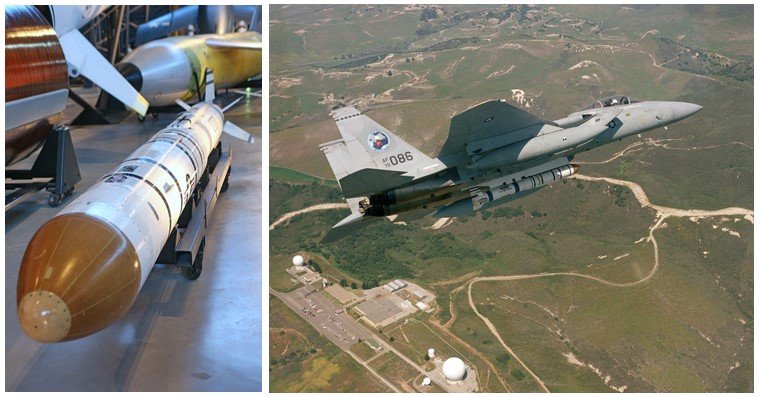
On the left, the American ASM-135 ASAT missile. Image source: wikimedia.commons. On the right, an F-15 fighter with an anti-satellite missile (ASAT). Image source: The U.S. National Archives
The United States is able to interfere civilian signals from GPS, GLONASS and BeiDou satellite navigation services locally, within its area of operation to prevent the effective use of adversary navigation services. The United States is also likely to have the ability to disrupt military satellite navigation services.
NASA (the National Aeronautics and Space Administration) is an aeronautics and space administration agency under the U.S. Government. It is responsible for the United States space program and for civil aviation research. The agency employs nearly 18,000 people and works with many U.S. companies, universities and international and commercial partners. Its notable programs include the Artemis lunar program and the Mars program.
Space tourism refers to space travel in which tourists pay for their own travel. The forms of space travel include expeditions to space centres, “vomit comet” flights simulating weightlessness, and “edge of space” flights in an aircraft flying high into the upper atmosphere. Ongoing projects include Boeing’s Starliner and SpaceX’s Axiom Space and Polaris programmes. These businesses contribute not only to the development of space technology, but also to the development of military capabilities in space.
Sources and links
U.S. Combatant Commands:
https://www.defense.gov/Our-Story/Combatant-Commands/
U.S. Space Command:
https://www.spacecom.mil/
U.S. Space Force:
https://www.spaceforce.mil/
https://en.wikipedia.org/wiki/United_States_Space_Force
U.S. Defense Space Strategy, June 2020:
https://media.defense.gov/2020/Jun/17/2002317391/-1/-1/1/2020_DEFENSE_SPACE_STRATEGY_SUMMARY.PDF